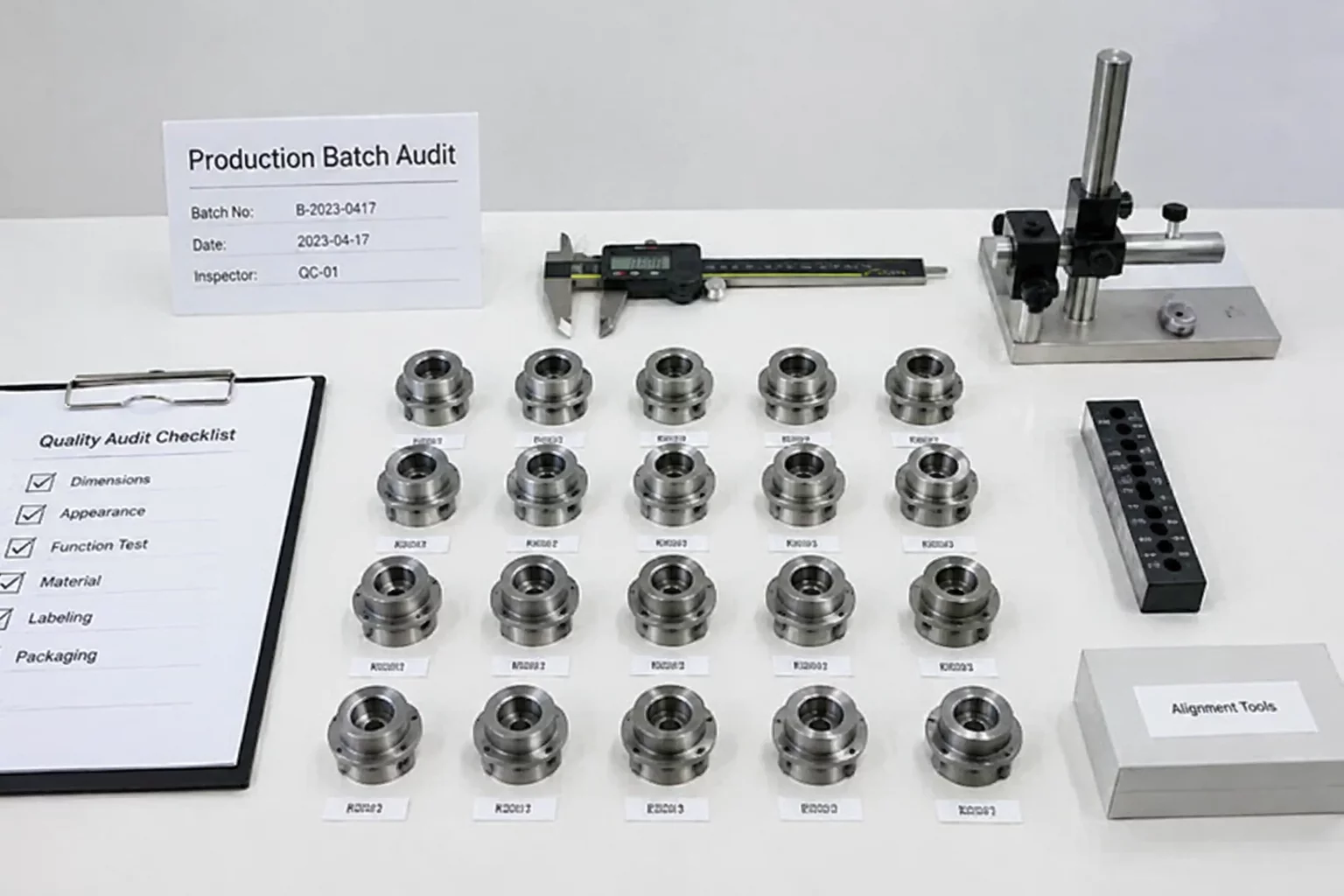
Batch Consistency
Cross Variant Inspection
Systematic quality validation protocols for side-by-side variable text layouts across repeated physical cut dies.
Systematic quality validation protocols for side-by-side variable text layouts across repeated physical cut dies.

When generating dozens of personalized names on a single die-cut contour, optical discrepancies emerge between compact glyph combinations and extended letter sequences. Cross variant inspection establishes a side-by-side auditing protocol that locks optical mass, baseline stability, and safe-cut offsets across the entire production sheet.
Variable typography presents an insidious challenge in serialized production. Short names like Jo occupy minimal horizontal space, temptingly leaving broad negative fields on either flank. Extended strings like Christopher crowd die boundaries, forcing the human eye to perceive differing densities even when point sizes match mathematically.
Inspection procedures begin by grouping names into discrete character clusters. Designers often rely on automated auto-fit settings in cutting software, yet algorithmic scaling drops font sizes disproportionately. Cross variant inspection isolates these outliers before the blade cuts material, ensuring that neighboring labels preserve identical baseline heights and unified visual anchors across physical surfaces.
Visual hierarchy depends directly on letterform mass rather than geometric bounding envelopes. When evaluating two adjacent stickers on the same cutting mat, a bold capitals structure draws considerably more presence than mixed-case entries with descenders.
A mechanically centered label frequently appears off-balance on finished merchandise. Genuine batch harmony demands matched optical volume rather than unbending geometric alignment.
Inspectors apply transparent overlay masks across digital artboards. By superimposing the lightest entry onto the heaviest entry, operators pinpoint excessive tracking or dangerous proximity to contour perimeters. Minor micro-kerning adjustments resolve tension without breaking family cohesion.
Mechanical cutter travel creates lateral drift that compounds across wide sheets. An acceptable 0.25 mm offset in quadrant one can manifest as an intolerable 0.60 mm clip in quadrant four.
Final batch approval requires a printed proof sheet reviewed under neutral 5000K illumination. Operators place a millimeter grid transparent film across all duplicate badges, confirming that horizontal centerlines remain true from top left to bottom right. This five-minute check avoids wasted vinyl, protects brand standards, and guarantees client satisfaction on every custom set.
Standardized mechanical and optical thresholds applied across variant name lengths when proofing combined gang sheets.
| Variant Scope | Allowed Shift | Optical Density | Compliance State |
|---|---|---|---|
| Short Names (2-4 Characters) | ±0.20 mm | 1.15 W/H Ratio Target | Verified |
| Medium Names (5-8 Characters) | ±0.25 mm | 1.00 Reference Target | Verified |
| Extended Names (9+ Characters) | ±0.35 mm | 0.88 Condensed Limit | Verified |
Run through these critical inspection steps before launching high-volume cutter sweeps.
Superimpose the shortest name variant directly over the longest entry in your vector preview to confirm shared visual centerlines.
Measure the narrowest clearance gap between terminal character serifs or flourishes and the cut line boundary against the 2.5 mm safety zone.
Audit condensed long strings to ensure kerning pairs do not choke ink fill or merge adjacent vertical stems during print reproduction.
Inspect corner alignment markers across the entire gang layout to catch micro-skew across the cutter carriage path.
Examine companion technical briefs regarding registration preservation, vector cut boundaries, and variant typography.